
How Toyota Camry Maintenance Intervals Work
The Toyota Camry maintenance schedule follows a straightforward pattern built around 5,000-mile (or 6-month) intervals — whichever comes first. Every 5,000 miles you'll get the basics done: oil change, tire rotation, and a multi-point inspection. Then at 15,000 and 30,000-mile intervals, additional items like cabin air filters, brake inspections, and fluid replacements get layered in.
This pattern repeats across every Camry generation, though the specific fluids, capacities, and replacement intervals vary by model year and engine type. Below, we break down the exact schedule for each generation so you know precisely what your Camry needs and when.
🔍 Find Your Generation
2025 or newer → 9th Generation (all-hybrid lineup)
2018–2024 → 8th Generation (TNGA platform, most common on the road today)
2012–2017 → 7th Generation (proven reliability, still widely driven)
2007–2011 → 6th Generation (2.4L / 3.5L V6 / hybrid — check the oil notes)
2002–2006 → 5th Generation (V6 models have a timing belt)
1997–2001 → 4th Generation (timing belt on every engine)
1992–1996 → 3rd Generation (timing belt, older fluid specs)
Not sure? Check your VIN or the sticker inside the driver's door jamb for the model year.
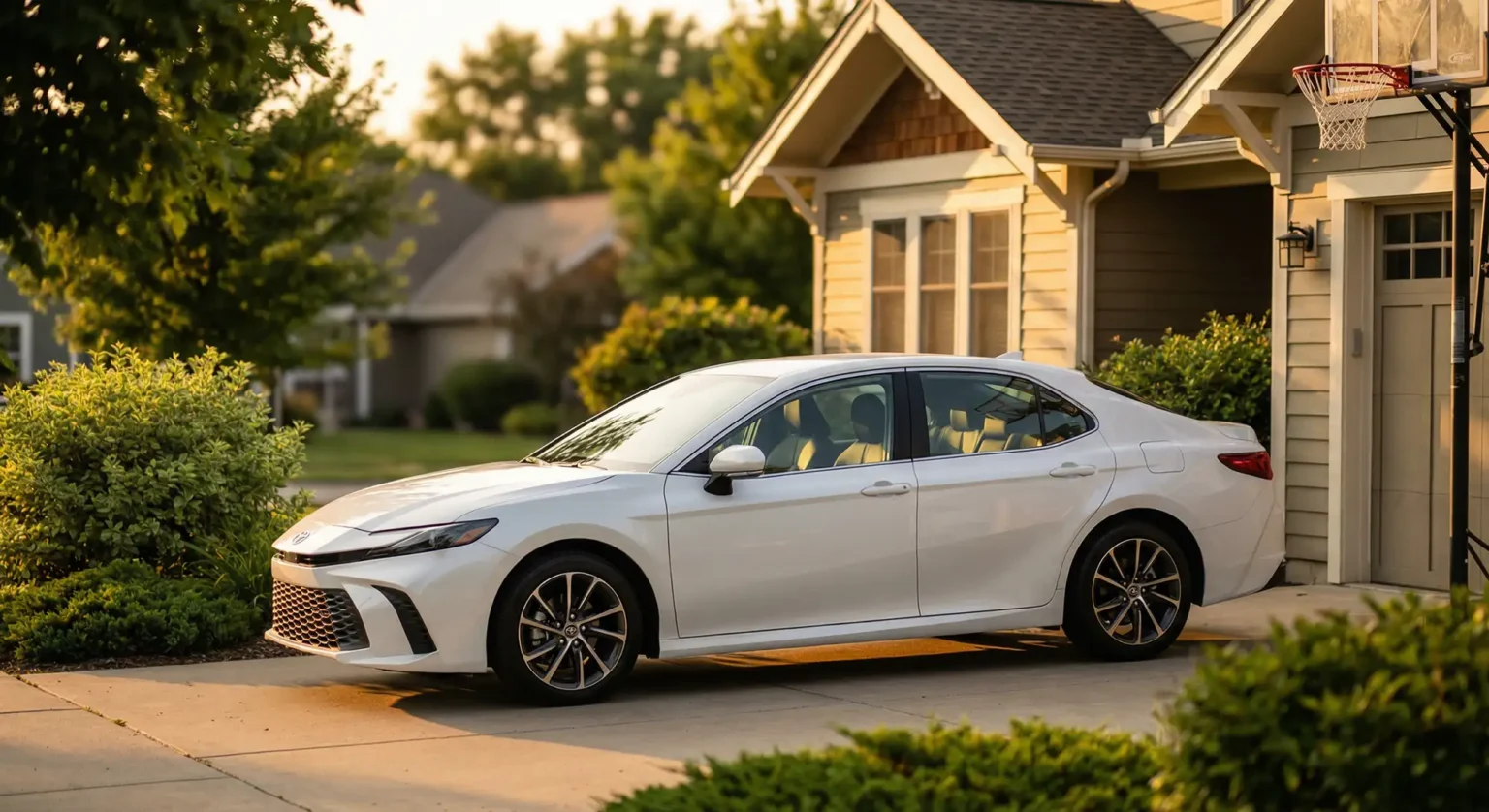
2025–Present Toyota Camry
The 9th-generation Camry moved to an all-hybrid lineup, which changes some maintenance dynamics. The regenerative braking system means brake pads tend to last significantly longer, and the hybrid battery system requires no routine maintenance under normal conditions. Otherwise, the core schedule stays familiar.
| Service Item | Interval | Notes |
|---|---|---|
| Oil & filter change | Every 5,000 mi / 6 mo | 0W-20 synthetic required |
| Tire rotation | Every 5,000 mi / 6 mo | Check pressure monthly |
| Cabin air filter | Every 10,000 mi / 12 mo | Replace, not just inspect |
| Engine air filter | Every 30,000 mi / 36 mo | Inspect at 15k, replace at 30k |
| Brake inspection | Every 15,000 mi / 18 mo | Pads last longer due to regen braking |
| Coolant | First at 100,000 mi | Then every 50,000 mi after |
| Transmission fluid | Every 60,000 mi | Toyota WS ATF |
| Spark plugs | Every 60,000 mi | Iridium long-life plugs |
| Drive belts | Inspect at 60,000 mi | Replace as needed |
| Hybrid battery | No routine service | 10-year / 150,000 mi warranty |
Key Fluid Specs — 9th Gen Camry
kept on schedule.
Add your Camry in seconds. Get automatic maintenance reminders and track every service in one simple place.


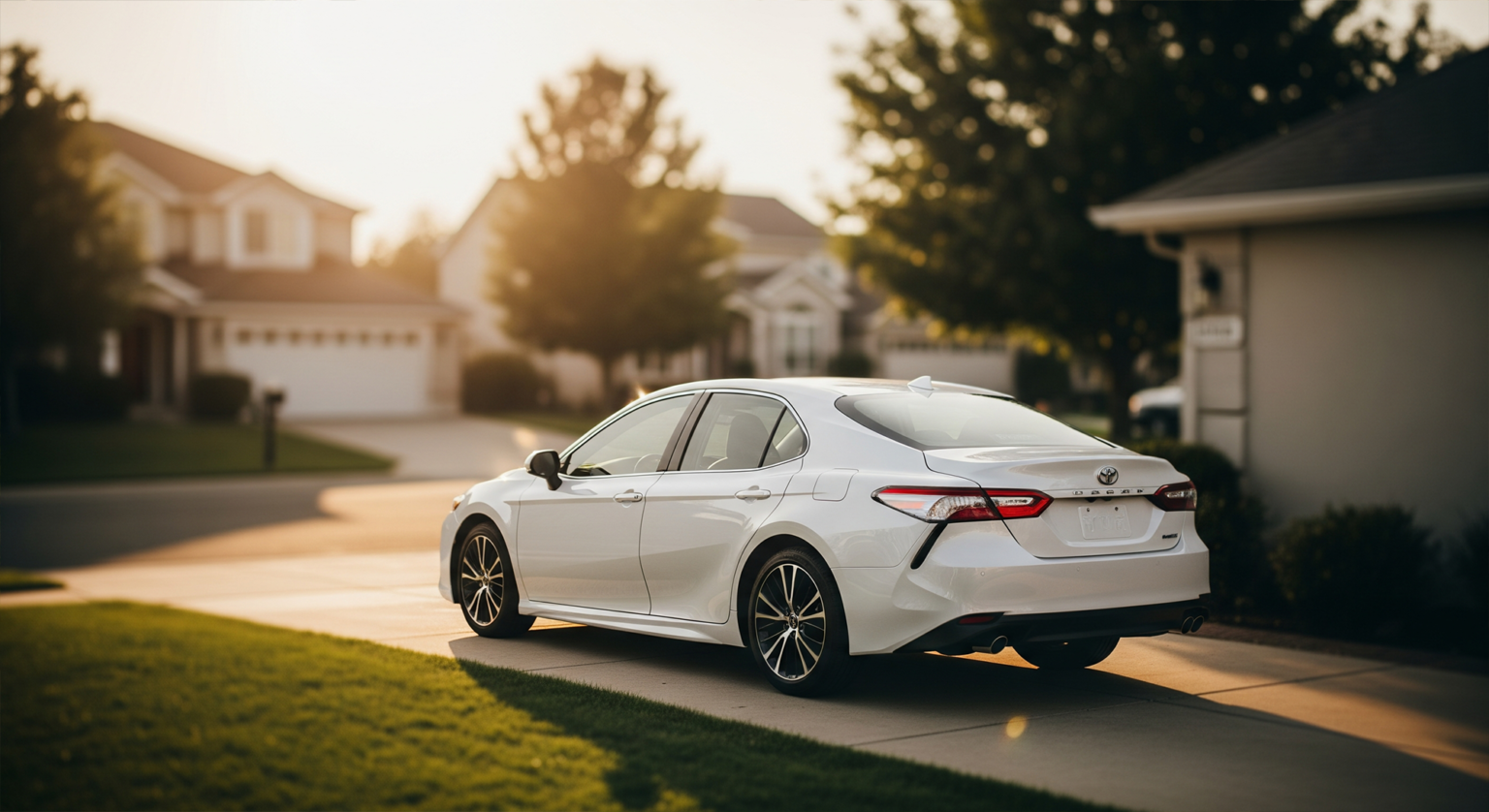
2018–2024 Toyota Camry
The 8th-generation Camry is the most common on the road today, built on Toyota's TNGA platform. It came in three powertrain options: a 2.5L four-cylinder (most popular), a 3.5L V6, and a hybrid. The maintenance schedule is largely the same across all three, with minor differences in oil capacity and the hybrid's brake wear patterns.
| Service Item | Interval | Notes |
|---|---|---|
| Oil & filter change | Every 5,000 mi / 6 mo | 0W-20 synthetic; can go 10k if using Toyota OEM 0W-20 |
| Tire rotation | Every 5,000 mi / 6 mo | Include with every oil change |
| Cabin air filter | Every 10,000 mi / 12 mo | Replace |
| Engine air filter | Every 30,000 mi / 36 mo | Inspect at 15k |
| Brake inspection | Every 15,000 mi / 18 mo | Inspect pads, rotors, lines, fluid |
| Brake fluid | Every 30,000 mi / 36 mo | DOT 3; inspect condition at each brake check |
| Coolant | First at 100,000 mi | Then every 50,000 mi; Toyota SLLC |
| Transmission fluid | Every 60,000 mi | Toyota WS ATF; do NOT flush, drain & fill only |
| Spark plugs | Every 60,000 mi | Iridium; some owners go to 90k but 60k is safer |
| Drive belts | Inspect at 60,000 mi | Then every 15k after; replace when cracked |
| Differential fluid (V6) | Every 50,000 mi | V6 models with rear diff only |
Key Fluid Specs — 8th Gen Camry
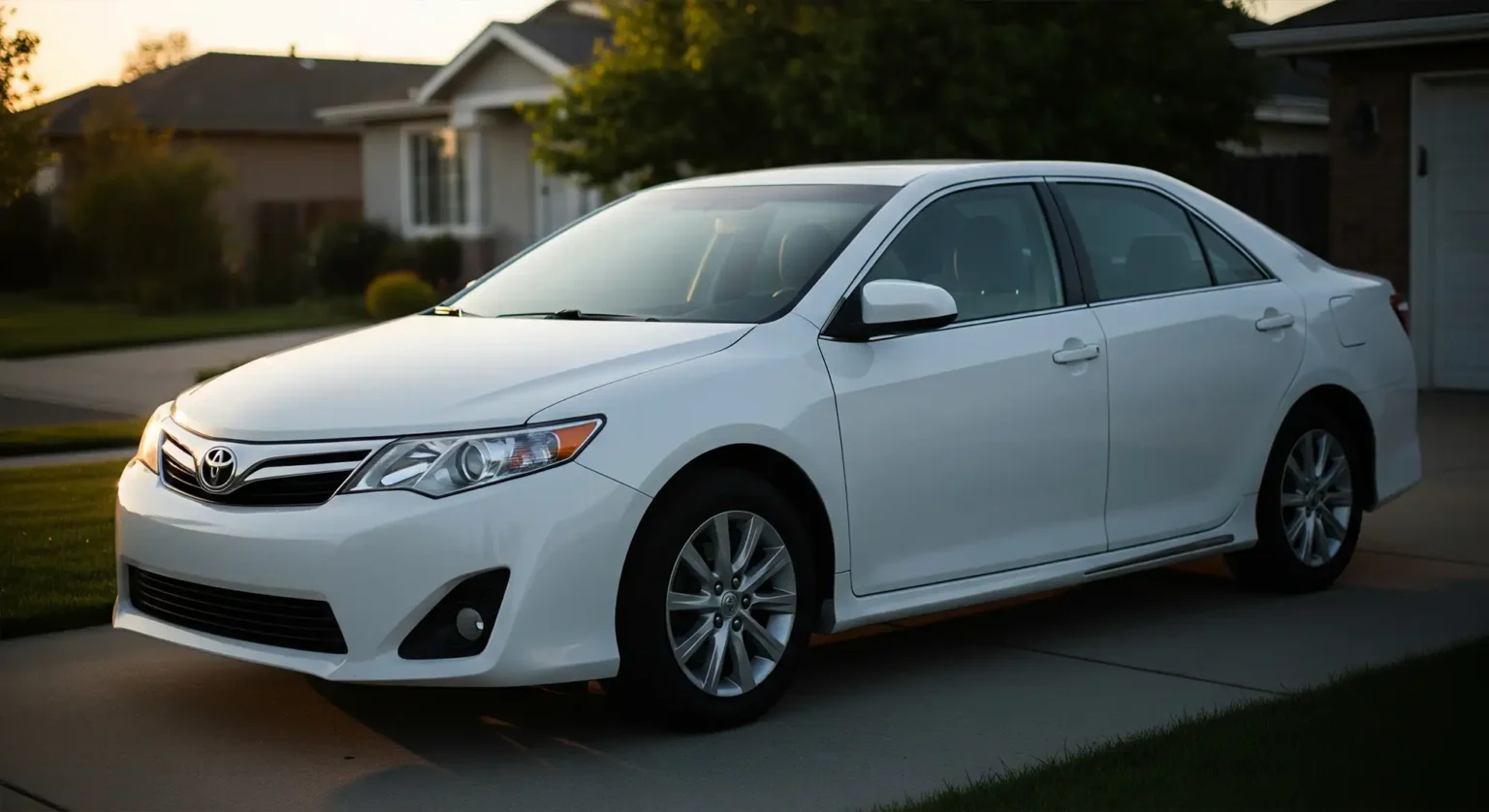
2012–2017 Toyota Camry
The 7th-generation Camry shares the same basic maintenance philosophy as the 8th gen but sits on an older platform. These are high-mileage vehicles now — many are at or past the 100,000-mile mark — so the longer-interval items like coolant, spark plugs, and transmission fluid become especially important to stay on top of.
| Service Item | Interval | Notes |
|---|---|---|
| Oil & filter change | Every 5,000 mi / 6 mo | 0W-20 synthetic for 2.5L; 0W-20 or 5W-30 for V6 (check cap) |
| Tire rotation | Every 5,000 mi / 6 mo | Critical as these cars age — tires wear unevenly |
| Cabin air filter | Every 10,000 mi / 12 mo | Behind the glove box; easy DIY |
| Engine air filter | Every 30,000 mi / 36 mo | Replace |
| Brake inspection | Every 15,000 mi / 18 mo | Pads, rotors, calipers, lines |
| Brake fluid | Every 30,000 mi / 36 mo | DOT 3 |
| Coolant | First at 100,000 mi | Then every 50,000 mi; Toyota SLLC |
| Transmission fluid | Every 60,000 mi | Toyota WS ATF; drain & fill, no flush |
| Spark plugs | Every 60,000 mi | Iridium |
| Drive belts | Inspect at 60,000 mi | Replace when cracked or glazed |
| Water pump | Inspect at 100,000 mi | Replace proactively if you see weeping |
Key Fluid Specs — 7th Gen Camry
Never miss a service
This schedule, on autopilot. Reminders arrive by mileage or date, before anything's overdue.
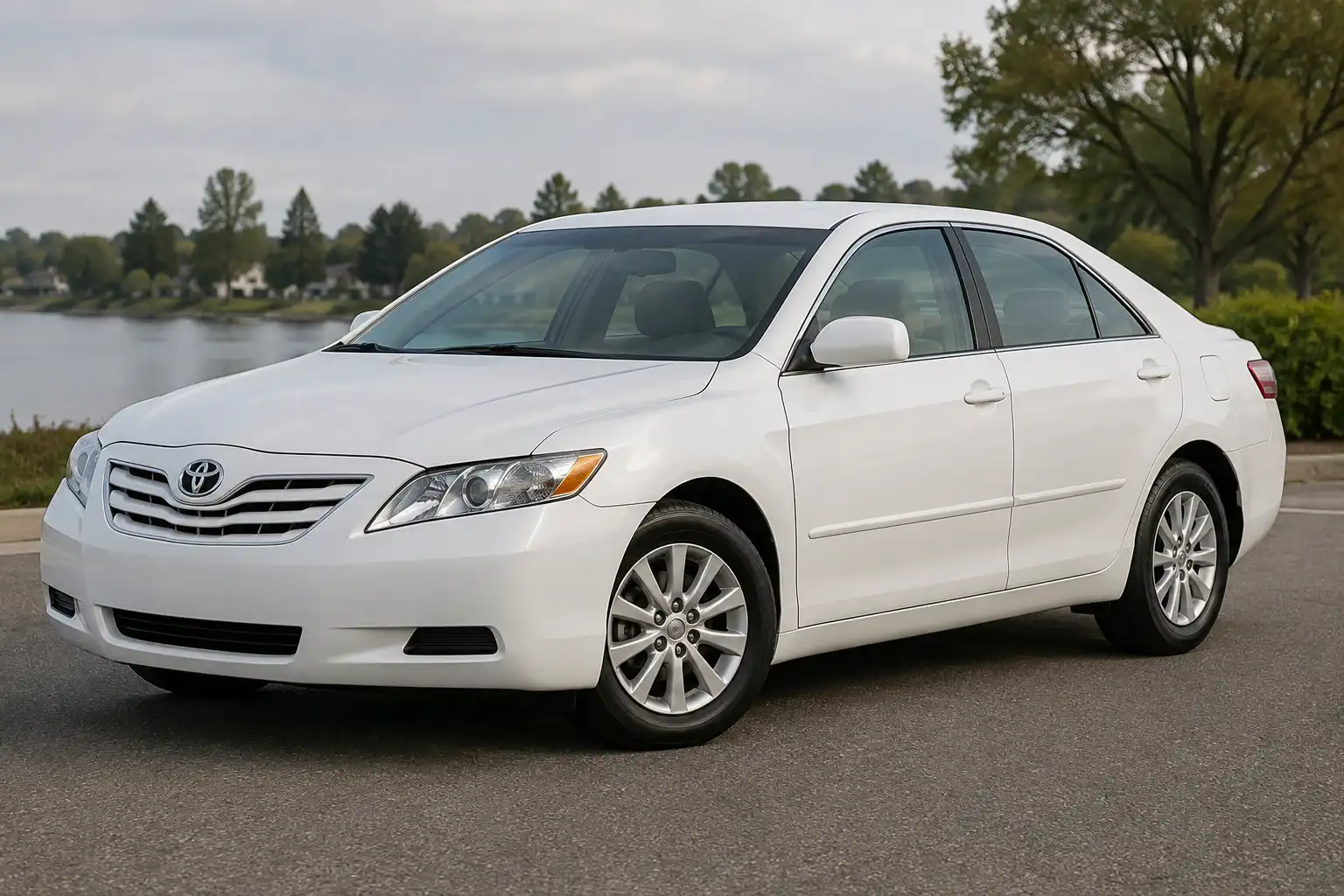
2007–2011 Toyota Camry
The 6th-generation Camry is where the maintenance picture genuinely diverges from the newer cars. These use 5W-30 oil, not 0W-20, for most of the run — the switch came with the 2.5L engine that arrived for 2010. Both the four-cylinder and the V6 use timing chains, so there's no timing belt service, but two well-documented engine issues make oil discipline more important on this generation than on any other.
| Service Item | Interval | Notes |
|---|---|---|
| Oil & filter change | Every 5,000 mi / 6 mo | 5W-30 for 2.4L & V6; 0W-20 for the 2010–11 2.5L |
| Tire rotation | Every 5,000 mi / 6 mo | Include with every oil change |
| Cabin air filter | Every 15,000 mi / 12 mo | Behind the glove box; 10-minute DIY |
| Engine air filter | Every 30,000 mi / 36 mo | Inspect at 15k |
| Brake inspection | Every 15,000 mi / 18 mo | Pads, rotors, calipers, lines |
| Brake fluid | Every 30,000 mi / 36 mo | DOT 3 |
| Coolant | First at 100,000 mi | Then every 50,000 mi; Toyota SLLC (pink) |
| Transmission fluid | Every 60,000 mi | Toyota WS ATF; drain & fill, no flush |
| Spark plugs | Every 120,000 mi | Iridium from the factory; many shops do 90k–100k |
| Serpentine belt | Inspect at 60,000 mi | No timing belt on this generation |
| PCV valve | Inspect at 60,000 mi | Cheap part; a stuck valve worsens oil consumption |
| Hybrid inverter coolant | Inspect at 100,000 mi | Hybrid only; separate from engine coolant |
Key Fluid Specs — 6th Gen Camry
Two things every 2007–2011 Camry owner should know
1. The 2.4L oil consumption issue. The 2AZ-FE four-cylinder in these years can burn oil — sometimes a quart every 1,200 miles — because of undersized oil return holes behind the piston oil control rings. Toyota acknowledged it with Warranty Enhancement Program ZE7, covering certain 2007–2009 Camry and 2007–2011 Camry Hybrid models. That coverage has long since expired, but the takeaway stands: check the dipstick every other fill-up. The engines that died were the ones that ran dry between 5,000-mile oil changes, not the ones that simply burned oil.
2. The V6 VVT-i oil hose. The 3.5L 2GR-FE built before roughly April 2008 used a rubber section in the VVT-i oil supply line that can rupture and dump the engine's oil in under a minute. Toyota covered it under Limited Service Campaign 90K for certain 2007–2010 Camrys, and later engines came with an all-metal line from the factory. If you have a 2007 or 2008 V6 and can't confirm the repair was done, run your VIN through Toyota's recall lookup.
Free Camry reminders on your phone. No account needed.
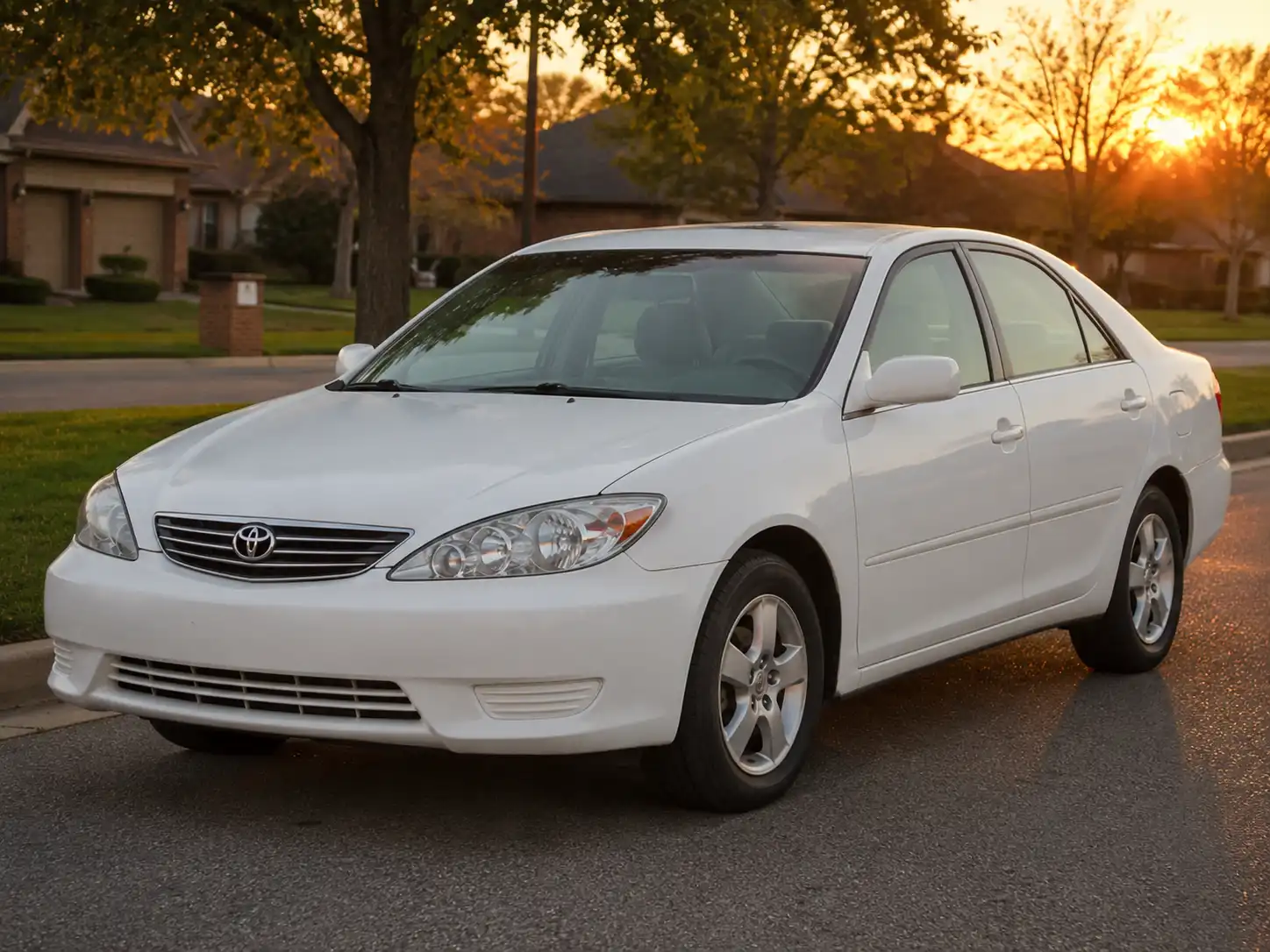
2002–2006 Toyota Camry
This is the generation where the schedule stops resembling anything newer. Both V6 engines use a timing belt that must be replaced every 90,000 miles. The transmission takes Type T-IV ATF, not WS — a common and expensive mix-up. And early cars left the factory with red Long Life Coolant on a 30,000-mile interval rather than the pink 100,000-mile coolant.
| Service Item | Interval | Notes |
|---|---|---|
| Oil & filter change | Every 5,000 mi / 6 mo | 5W-30; the manual allows longer, 5k is safer at this age |
| Tire rotation | Every 5,000 mi / 6 mo | Watch for uneven wear from tired struts |
| Cabin air filter | Every 15,000 mi / 12 mo | Not fitted to every trim — check first |
| Engine air filter | Every 30,000 mi / 36 mo | Inspect at 15k |
| Brake inspection | Every 15,000 mi / 18 mo | Rear drum models: check shoes and wheel cylinders |
| Brake fluid | Every 30,000 mi / 36 mo | DOT 3 |
| Coolant — red LLC | Every 30,000 mi / 24 mo | 2002–04 factory fill; concentrate, must be diluted |
| Coolant — pink SLLC | First at 100,000 mi | 2005–06 factory fill; then every 50,000 mi |
| Timing belt (V6 only) | Every 90,000 mi / 7 yr | Do the water pump at the same time |
| Transmission fluid | Every 60,000 mi | Toyota Type T-IV ATF — not WS |
| Spark plugs | Every 60,000–120,000 mi | 60k for standard plugs, 120k if iridium is fitted |
| Serpentine belt | Inspect at 60,000 mi | Replace when cracked or glazed |
| Valve cover gasket | Inspect at 100,000 mi | Common leak point; oil in the plug wells is the tell |
Key Fluid Specs — 5th Gen Camry
Watch the oil on 2.4L cars. The same oil consumption tendency that affects the 6th gen applies here, and 2002–2006 cars also had a known problem with stripped cylinder head bolt threads in the aluminum block. Symptoms are coolant loss with no visible leak, or a head gasket that fails again after a repair. A proper fix uses thread inserts — ask any shop quoting a head gasket job on one of these whether they plan to.
Log oil changes, rotations and repairs in seconds. Your Camry's full history stays ready for the next service visit or resale.
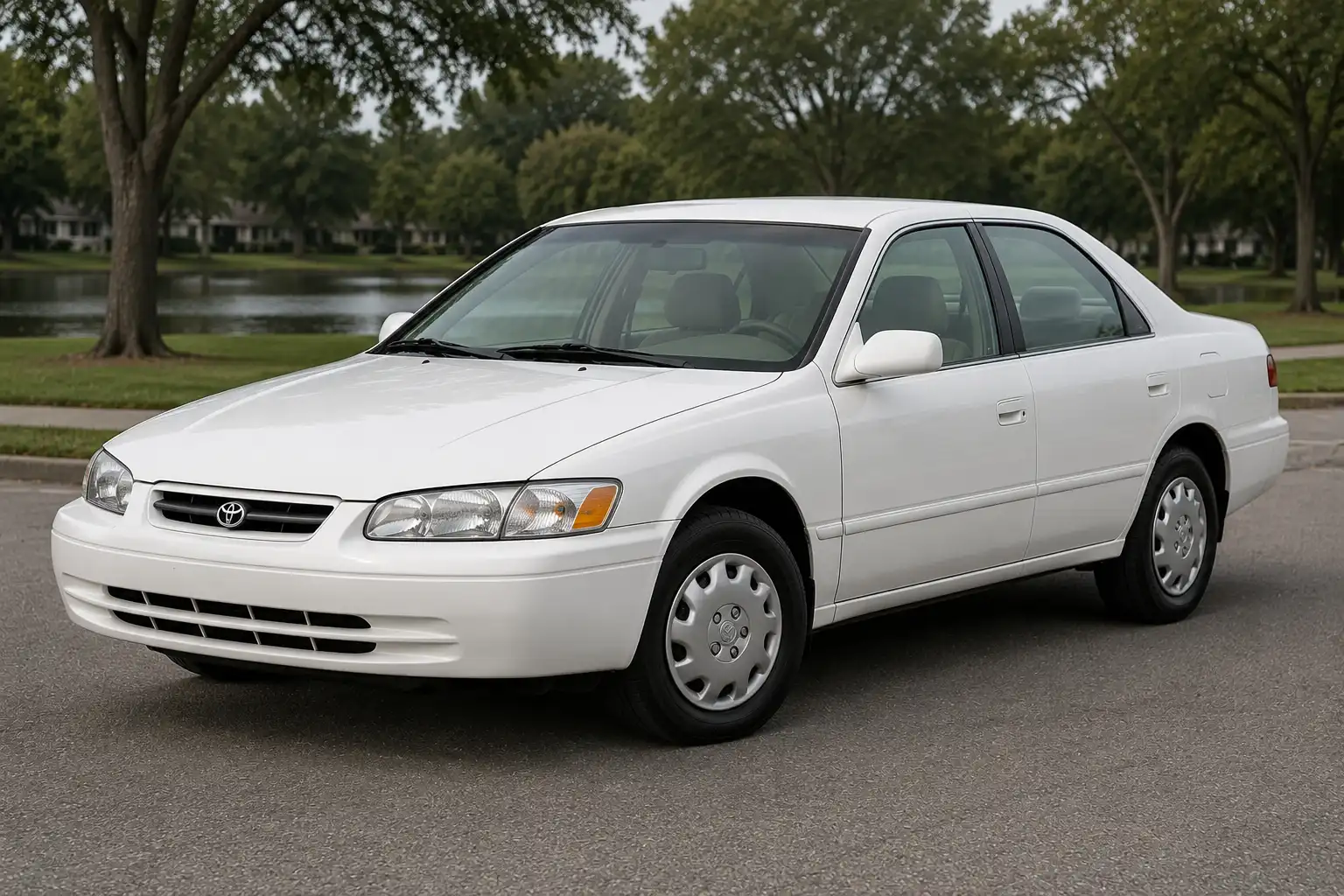
1997–2001 Toyota Camry
Plenty of these are still running, and the ones that are tend to be owned by people who understand that the 90,000-mile timing belt is non-negotiable — both engines have one here, not just the V6. The fluid specs are older across the board: 5W-30 oil, red coolant on a 30,000-mile clock, and Dexron ATF rather than any of Toyota's later formulations.
| Service Item | Interval | Notes |
|---|---|---|
| Oil & filter change | Every 5,000 mi / 6 mo | 5W-30; the manual's 7,500-mi figure assumes ideal conditions |
| Tire rotation | Every 5,000 mi | Inspect struts and bushings while it's on the lift |
| Engine air filter | Every 30,000 mi | Inspect at 15k |
| Brake inspection | Every 15,000 mi | Most have rear drums — check shoes and cylinders |
| Brake fluid | Every 30,000 mi / 24 mo | DOT 3 |
| Coolant | Every 30,000 mi / 24 mo | Toyota LLC (red concentrate) — dilute before filling |
| Timing belt | Every 90,000 mi / 7 yr | Both engines; water pump at the same time |
| Transmission fluid | Every 30,000 mi | Dexron III (Dexron VI-compatible is fine) |
| Spark plugs | Every 30,000 mi | Or 60,000–90,000 if upgraded to platinum/iridium |
| Distributor cap & rotor | Inspect at 60,000 mi | 1997 4-cyl only; later years use DIS |
| PCV valve | Every 60,000 mi | Cheap, easy, and helps control sludge |
| Cam & crank seals | Inspect at 90,000 mi | Do them during the timing belt job |
Key Fluid Specs — 4th Gen Camry
The sludge era. The 3.0L V6 from this period developed a reputation for oil sludge, and Toyota eventually ran an owner assistance policy for affected engines. The cause was long oil change intervals combined with short-trip driving. A 1997–2001 V6 that's been on 5,000-mile changes is generally fine; one with unknown history deserves a look under the oil cap before you trust it. If the underside looks like coffee grounds, walk away or budget for a rebuild.
1992–1996 Toyota Camry
A 30-plus-year-old Camry is maintained by condition as much as by mileage, but the core schedule still applies. At this age the rubber and the fluids matter more than anything on the interval chart: hoses, the timing belt, brake lines, and the automatic transmission fluid that has very likely never been changed.
| Service Item | Interval | Notes |
|---|---|---|
| Oil & filter change | Every 5,000 mi / 6 mo | 5W-30 or 10W-30; high-mileage oil is fine |
| Timing belt (1994–96 V6, all 4-cyl) | Every 90,000 mi | Water pump, tensioner and seals at the same time |
| Timing belt (1992–93 V6) | Every 60,000 mi | Shorter interval on the earlier V6 |
| Coolant | Every 30,000 mi / 24 mo | Toyota LLC (red) or an Asian-formula equivalent |
| Transmission fluid | Every 30,000 mi | Dexron III; drain & fill only on a high-mileage unit |
| Brake fluid | Every 24 mo | Age matters more than mileage at this point |
| Spark plugs | Every 30,000 mi | Standard copper plugs from the factory |
| Coolant & vacuum hoses | Inspect annually | Original rubber is well past its service life |
| Fuel filter | Every 60,000 mi | In-line filter, unlike later in-tank designs |
Skip the spreadsheet. Your Camry's schedule loads automatically and tells you what's next.
-
Schedule pre-loadedPick your Camry and the intervals are set up for you.
-
Smart remindersNudges by miles or months, whichever comes first.
-
Full service historyEvery oil change and repair, logged in one place.
Toyota Camry Oil Change Intervals by Year
Every Camry generation runs on the same 5,000-mile (or 6-month) oil change rhythm. What changes across the years is the grade. Anything from 2010 onward with a 2.5L engine takes 0W-20 full synthetic; anything older generally takes 5W-30. The 3.5L V6 straddles the change — 5W-30 through 2011, 0W-20 from 2012.
If you're using genuine Toyota 0W-20, some 8th and 9th gen models allow extending to 10,000-mile intervals — but most mechanics recommend sticking with 5,000 miles, especially for city driving or short trips.
| Engine | Years | Oil Type | Capacity (w/ filter) |
|---|---|---|---|
| 2.5L 4-cyl hybrid (9th gen) | 2025+ | 0W-20 | ~4.8 qt |
| 2.5L 4-cyl (8th gen) | 2018–2024 | 0W-20 | 4.8 qt |
| 3.5L V6 (8th gen) | 2018–2024 | 0W-20 | 5.7 qt |
| 2.5L 4-cyl (7th gen) | 2012–2017 | 0W-20 | 4.6 qt |
| 3.5L V6 (7th gen) | 2012–2017 | 0W-20 / 5W-30 | 6.4 qt |
| 2.5L 4-cyl (6th gen) | 2010–2011 | 0W-20 | 4.6 qt |
| 2.4L 4-cyl (6th gen) | 2007–2009 | 5W-30 | 4.5 qt |
| 3.5L V6 (6th gen) | 2007–2011 | 5W-30 | 6.4 qt |
| 2.4L 4-cyl (5th gen) | 2002–2006 | 5W-30 | 4.5 qt |
| 3.0L V6 | 1994–2006 | 5W-30 | 5.0 qt |
| 3.3L V6 | 2004–2006 | 5W-30 | 5.0 qt |
| 2.2L 4-cyl | 1992–2001 | 5W-30 | ~3.8 qt |
Toyota Camry Transmission Fluid: When and How to Change It
Toyota officially considers the WS ATF in the Camry a "lifetime" fluid — meaning they don't include it in the standard maintenance schedule. However, this is widely debated, and most independent mechanics and Toyota enthusiasts strongly recommend a drain-and-fill every 60,000 miles to keep the transmission shifting smoothly.
The key is to never do a full power flush on a Camry automatic transmission. The recommended approach is a simple drain-and-fill, which replaces about 3–4 quarts of the roughly 7 quarts of total capacity. Doing this every 60,000 miles keeps the fluid fresh without disturbing deposits that a power flush can dislodge.
Use only genuine Toyota WS (World Standard) ATF. Aftermarket "compatible" fluids do not always meet Toyota's friction specifications and can cause shift quality issues over time.
Coolant Replacement Schedule
All modern Camrys use Toyota Super Long Life Coolant (SLLC), which is the pink-colored coolant pre-filled from the factory. The first replacement isn't needed until 100,000 miles, and after that, it should be replaced every 50,000 miles.
Don't mix coolant types. If your Camry was previously topped off with green or blue coolant at a non-Toyota shop, it's worth doing a full coolant system flush to get back to the correct Toyota SLLC. Mixing coolant chemistries can cause premature water pump seal degradation and reduced corrosion protection.
Brake Service & Inspection Schedule
Toyota recommends a brake inspection every 15,000 miles or 18 months. This includes checking pad thickness, rotor condition, caliper function, brake lines and hoses, and brake fluid condition.
On conventional (non-hybrid) Camrys, front brake pads typically last 30,000–50,000 miles depending on driving style, and rear pads last 40,000–60,000 miles. Hybrid Camry owners often see significantly longer brake pad life — sometimes 80,000+ miles — thanks to regenerative braking doing most of the stopping work.
Brake fluid should be replaced every 30,000 miles or 36 months. Brake fluid is hygroscopic (it absorbs moisture from the air), and contaminated fluid leads to a spongy pedal feel and reduced stopping power.
100,000-Mile Major Service: What Your Camry Needs
The 100,000-mile mark is a milestone for any Camry. In addition to all the regular interval items, this is when several long-life components come due for the first time:
Coolant replacement — first change for Toyota SLLC. Spark plugs — second set if you replaced at 60k, or first set if you stretched them. Drive belts — replace if not already done; inspect for cracks, fraying, or glazing. Water pump inspection — look for weeping or play in the bearing. Transmission fluid — should be on your second drain-and-fill by now if following the 60k recommendation.
A comprehensive 100,000-mile service at a Toyota dealer typically runs $400–$800 depending on your region and what needs replacing. Independent shops are usually 20–40% less. Either way, it's far cheaper than the engine or transmission problems that deferred maintenance can cause.
How to Track Your Toyota Camry Maintenance
Staying on top of all these intervals is a lot easier with a dedicated app than a glovebox full of receipts. MyAutoLog comes with built-in service presets for the Toyota Camry — including oil changes, brake inspections, cabin filters, and transmission fluid — so you can start logging immediately without any manual setup.
The app sends smart reminders based on both mileage and time intervals, tracks costs per service, and lets you attach photos of receipts. When it's time to sell your Camry, you can export the entire service history as a polished PDF report — a proven way to increase buyer confidence and get a better price.
Toyota Camry Timing Belt or Timing Chain? By Year
This is the single most expensive thing to get wrong on an older Camry, and the answer depends on both the year and the engine. Toyota moved the four-cylinder to a timing chain in 2002 and the V6 in 2007. Anything with a belt needs it replaced on schedule; anything with a chain has no scheduled replacement at all.
| Years | Engine | Belt or Chain? | Replacement Interval |
|---|---|---|---|
| 2002–Present | All 4-cylinder | Chain | None scheduled |
| 2007–Present | All V6 | Chain | None scheduled |
| 2002–2006 | 3.0L / 3.3L V6 | Belt | 90,000 mi or 7 years |
| 1994–2001 | 3.0L V6 | Belt | 90,000 mi or 7 years |
| 1992–1993 | 3.0L V6 | Belt | 60,000 mi |
| 1992–2001 | 2.2L 4-cyl | Belt | 90,000 mi or 7 years |
The belt-driven Camry engines are non-interference designs, which is unusually forgiving. If the belt breaks, the engine simply stops rather than destroying itself — a tow and a belt job instead of bent valves and a four-figure repair. Most belt failures are actually caused by a seized water pump, tensioner or idler pulley rather than the belt itself, which is exactly why the whole kit gets replaced together.
On the chain-driven engines there's no service interval, but a chain isn't maintenance-free forever. A rattle on cold startup that lasts a second or two is the classic early sign of a stretched chain or a worn tensioner, and it's almost always the result of extended oil change intervals. Regular oil changes are the timing chain maintenance.
Never miss a service
This schedule, on autopilot. Reminders arrive by mileage or date, before anything's overdue.
Frequently Asked Questions
Every 5,000 miles or 6 months, whichever comes first, using 0W-20 full synthetic oil. This applies to all modern Camry generations (7th, 8th, and 9th gen).
Toyota considers it a "lifetime" fluid, but most mechanics recommend a drain-and-fill with Toyota WS ATF every 60,000 miles. Avoid full power flushes — a simple drain and refill is the safer approach.
The first coolant replacement is at 100,000 miles, then every 50,000 miles after that. Use Toyota Super Long Life Coolant (SLLC) — the pink coolant — and don't mix it with other types.
On conventional Camrys, front pads typically last 30,000–50,000 miles and rears last 40,000–60,000 miles. Hybrid models often see 80,000+ miles due to regenerative braking.
It's a mileage-based reminder that triggers every 5,000 miles to tell you it's time for routine service — usually an oil change and tire rotation. It's not a warning light indicating a problem. You can reset it yourself after completing the service.
A comprehensive 100k service at a Toyota dealer typically costs $400–$800 depending on your area and what needs replacing. Independent shops are usually 20–40% less. This service includes coolant, spark plugs, drive belts, and a thorough inspection.
The 2018 Camry 2.5L four-cylinder takes 0W-20 full synthetic oil with a capacity of 4.8 quarts (with filter). The 3.5L V6 also takes 0W-20 with a capacity of 6.1 quarts (with filter).
Both engines in the 2007 Camry use a timing chain, so there's no scheduled replacement. The V6 does have a separate concern from that year: the rubber VVT-i oil supply hose on engines built before roughly April 2008, which Toyota addressed under Limited Service Campaign 90K. Check your VIN if the repair history is unknown.
Camry V6 models from 1994 through 2006 use a timing belt, replaced every 90,000 miles or 7 years. The 1992–1993 V6 uses a 60,000-mile interval. Replace the water pump, tensioner and idler pulleys at the same time — they sit behind the same cover, so the labor is already being paid for.
The 2008 Camry 2.4L four-cylinder takes 5W-30 with a capacity of 4.5 quarts including the filter. The 3.5L V6 also takes 5W-30, at 6.4 quarts. These are not 0W-20 engines — that grade arrived with the 2.5L engine in 2010.
The 2.4L engine in those years can consume oil because of undersized oil return holes behind the piston rings. Toyota covered it under Warranty Enhancement Program ZE7 for certain 2007–2009 Camry and 2007–2011 Camry Hybrid models, though that coverage has expired. If you own one, check the oil level every other fill-up — the engines that failed ran out of oil between changes.
Toyota Type T-IV ATF, not the WS fluid used from 2007 onward. The two are not interchangeable. Do a drain-and-fill every 60,000 miles rather than a power flush.
Not as a substitute for 5W-30 in engines that specify it. Camry engines built before 2010 were designed around 5W-30 oil clearances, and running a thinner oil can increase consumption in an engine that already tends toward it. The grade stamped on the oil filler cap is the one to use.
Every 30,000 miles or 24 months if it's still on the original red Long Life Coolant, which is what these shipped with. That's a much shorter interval than the 100,000 miles for the pink Super Long Life Coolant used from 2004 onward.
More Toyota Maintenance Schedules
We've built detailed maintenance guides for other popular Toyota models too:
Toyota RAV4 Maintenance Schedule — complete service intervals for the RAV4.
Toyota Corolla Maintenance Schedule (2014–2018) — oil, brakes, transmission, and more for the Corolla.
Toyota Tacoma Maintenance Schedule (2016–2023) — service guide for the Tacoma.
kept on schedule.
Add your Camry in seconds. Get automatic maintenance reminders and track every service in one simple place.